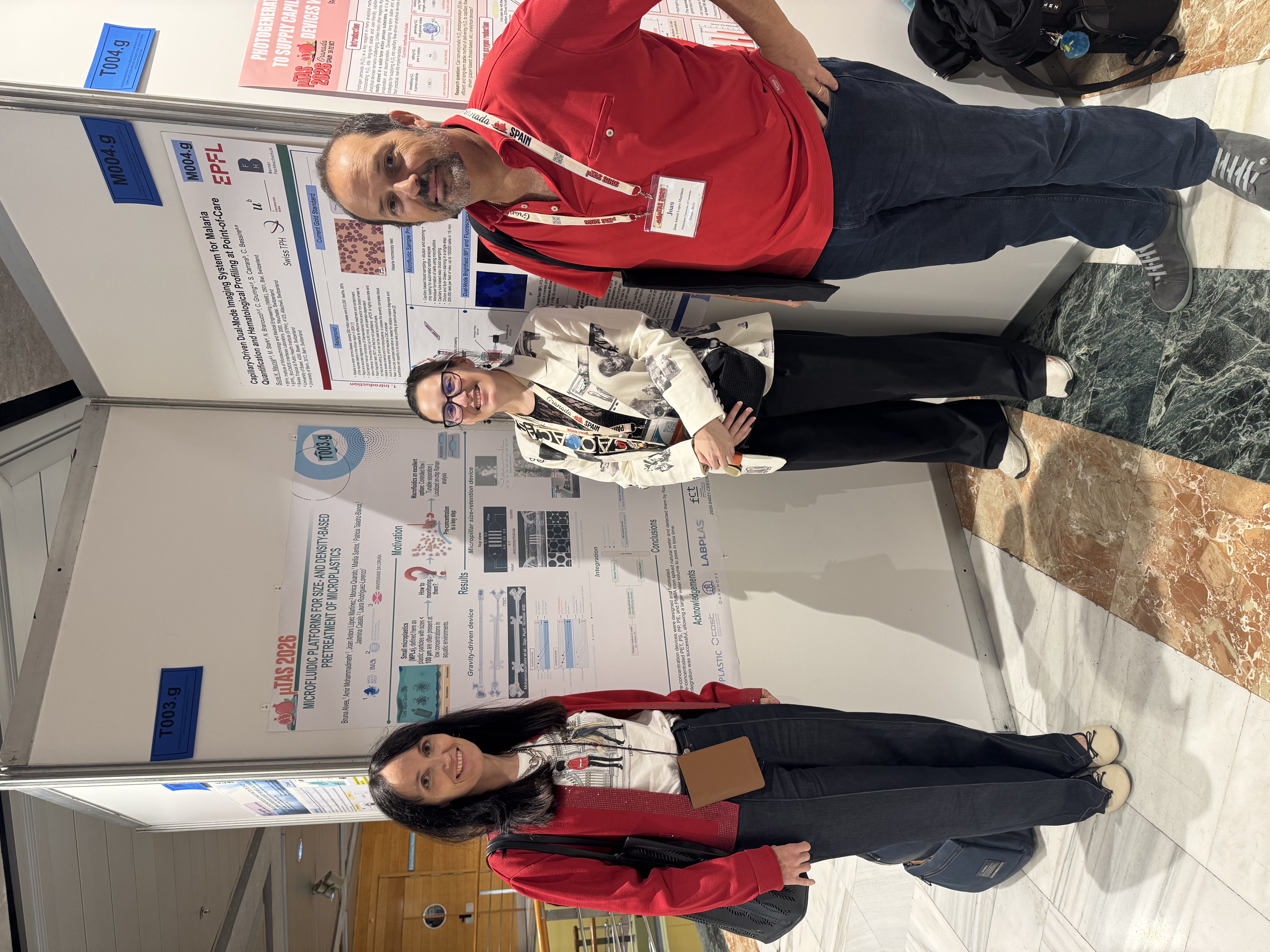
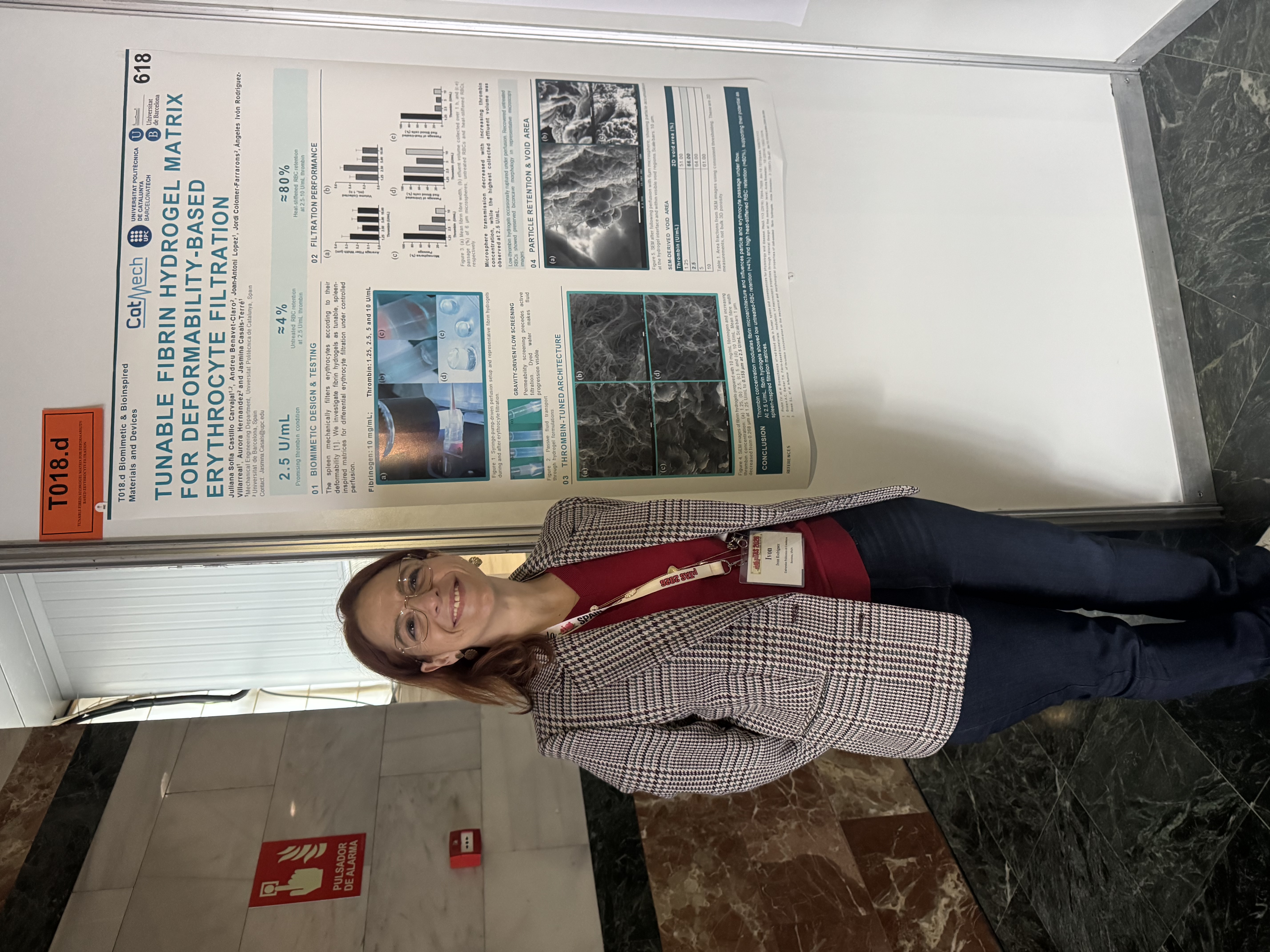
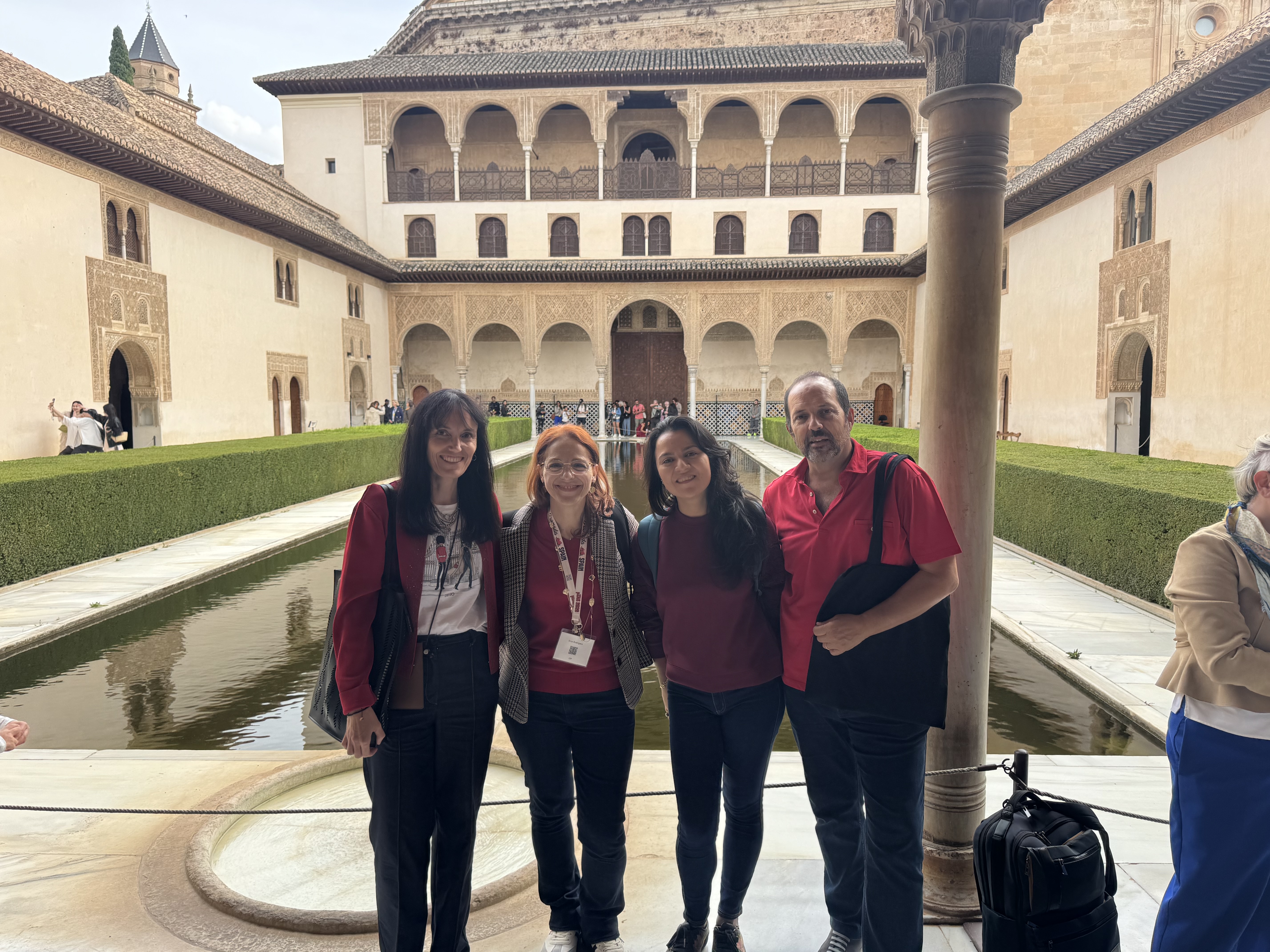
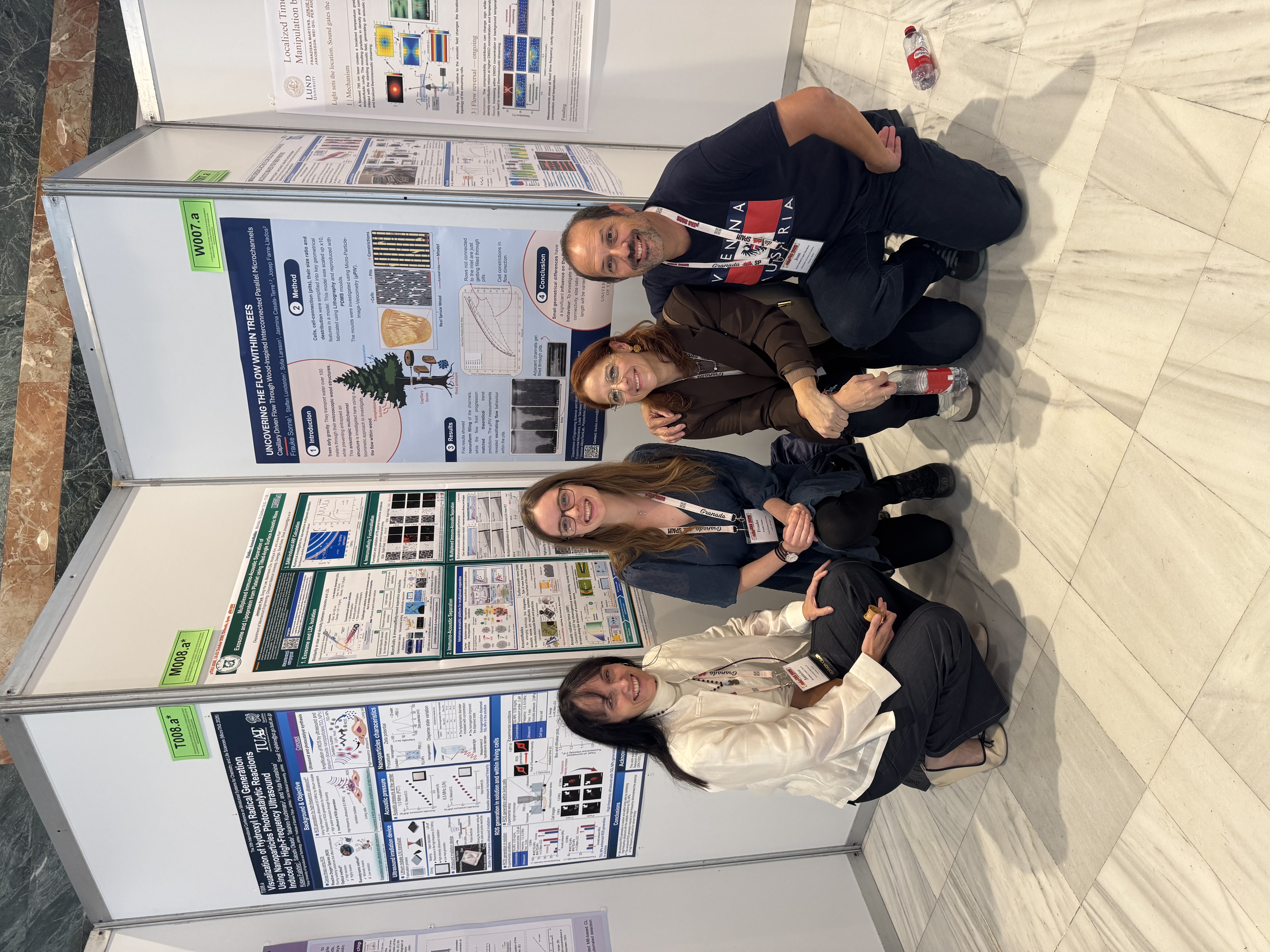
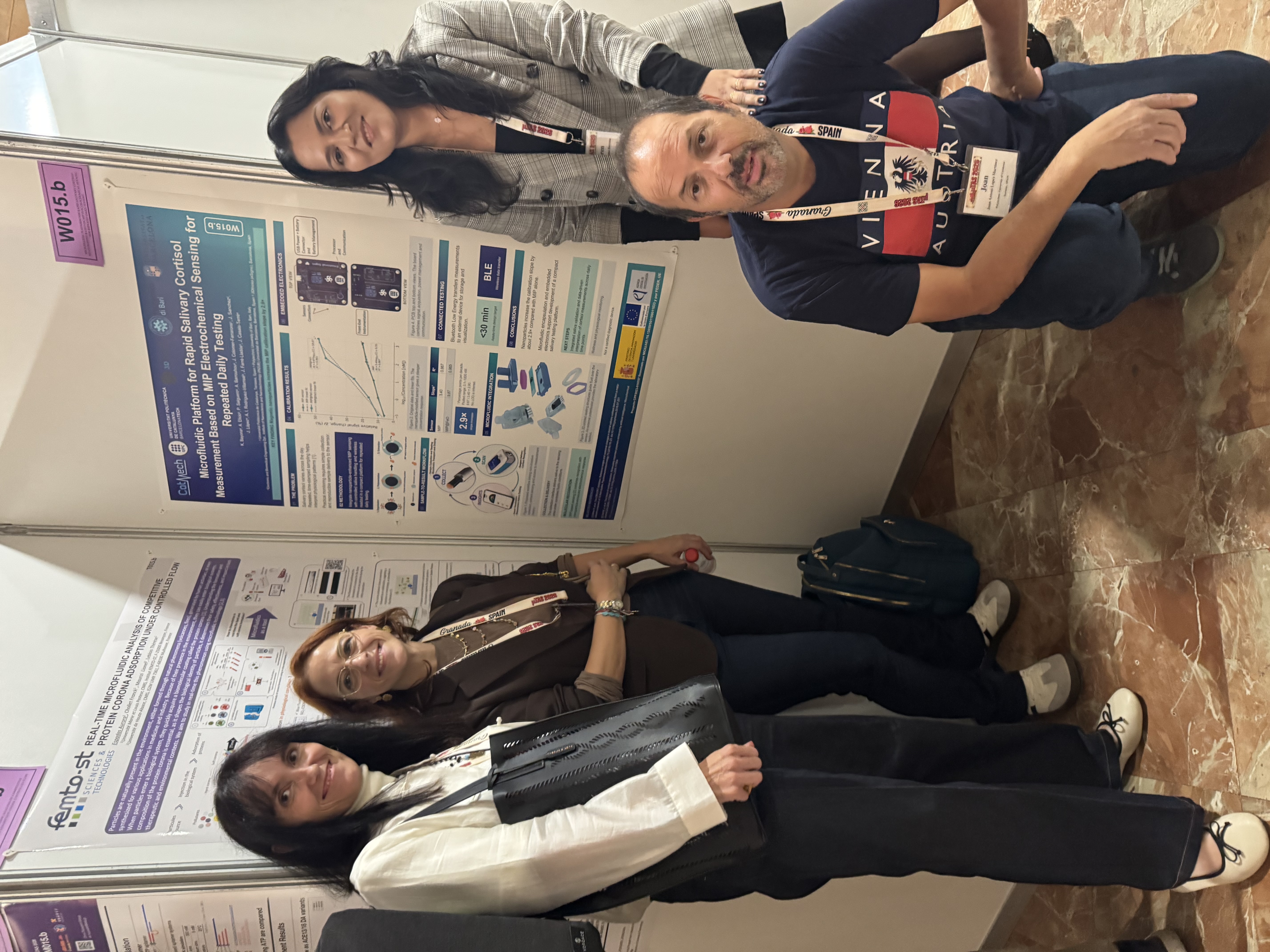
• MicroTech Lab – CATMECH, UPC-BarcelonaTech, participated in MicroTAS 2026 in Granada, sharing research spanning environmental analysis, biosensing, and microfluidic design.

    Our researchers contributed to four posters exploring:

    🔹 Microplastic analysis — microfluidic platforms for size- and density-based pretreatment of microplastics.

    🔹 Salivary cortisol sensing — a microfluidic platform integrating molecularly imprinted polymer (MIP) electrochemical sensing for repeated daily testing.

    🔹 Blood cell filtration — a tunable fibrin hydrogel matrix for deformability-based erythrocyte filtration.

    🔹 Bioinspired microfluidics — capillary-driven flow through wood-inspired hierarchical interconnected parallel microchannels.

    Jasmina Casals-Terré also chaired the session “Emerging Biointerfaces and Sensing Technologies,” contributing to the scientific exchange at the conference.

    A heartfelt thank you to all CATMECH researchers involved in these contributions, and to our co-authors and partner institutions. Your dedication, creativity, and teamwork make this research possible. Congratulations to everyone who helped develop, present, and share these results!

    Thank you also to conference chairs Lourdes Basabe Desmonts and Fernando Benito-López, the organizing team, and everyone who visited our posters for an inspiring week of discussions and new connections.
  • MicroTech Lab participated in MICRO 2026 – Plastic Pollution from Macro to nano, held in Cádiz, Spain, from 12 to 16 October 2026. The international conference brought together researchers and experts from different disciplines to share knowledge and discuss approaches to plastic pollution.

    During the conference, the team presented the poster “Integrated microfluidic system for preconcentration, size range sorting and Raman identification of small microplastics in water”. Developed in collaboration with INL and UDC, the work combines microfluidic preconcentration and sorting by size range with Raman identification, addressing key steps in the analysis of small microplastics in water.

    Participation in MICRO 2026 offered an opportunity to exchange ideas, explore complementary scientific approaches, and establish connections for potential future collaborations.

    MicroTech Lab congratulates all those involved in this collaborative research—Bruna Alvez, Amir Mohammadimehr, Joan Antoni Lopez-Martinez, Monica Quarato, Marilia Santos, Patricia Taladriz, Jasmina Casals-Terre, and Laura Rodriguez—for their contributions and dedication.

    MicroTech Lab thanks Carmen Morales Caselles, the local team in Cádiz, and the international organizing team for their dedication to fostering scientific exchange on plastic pollution.

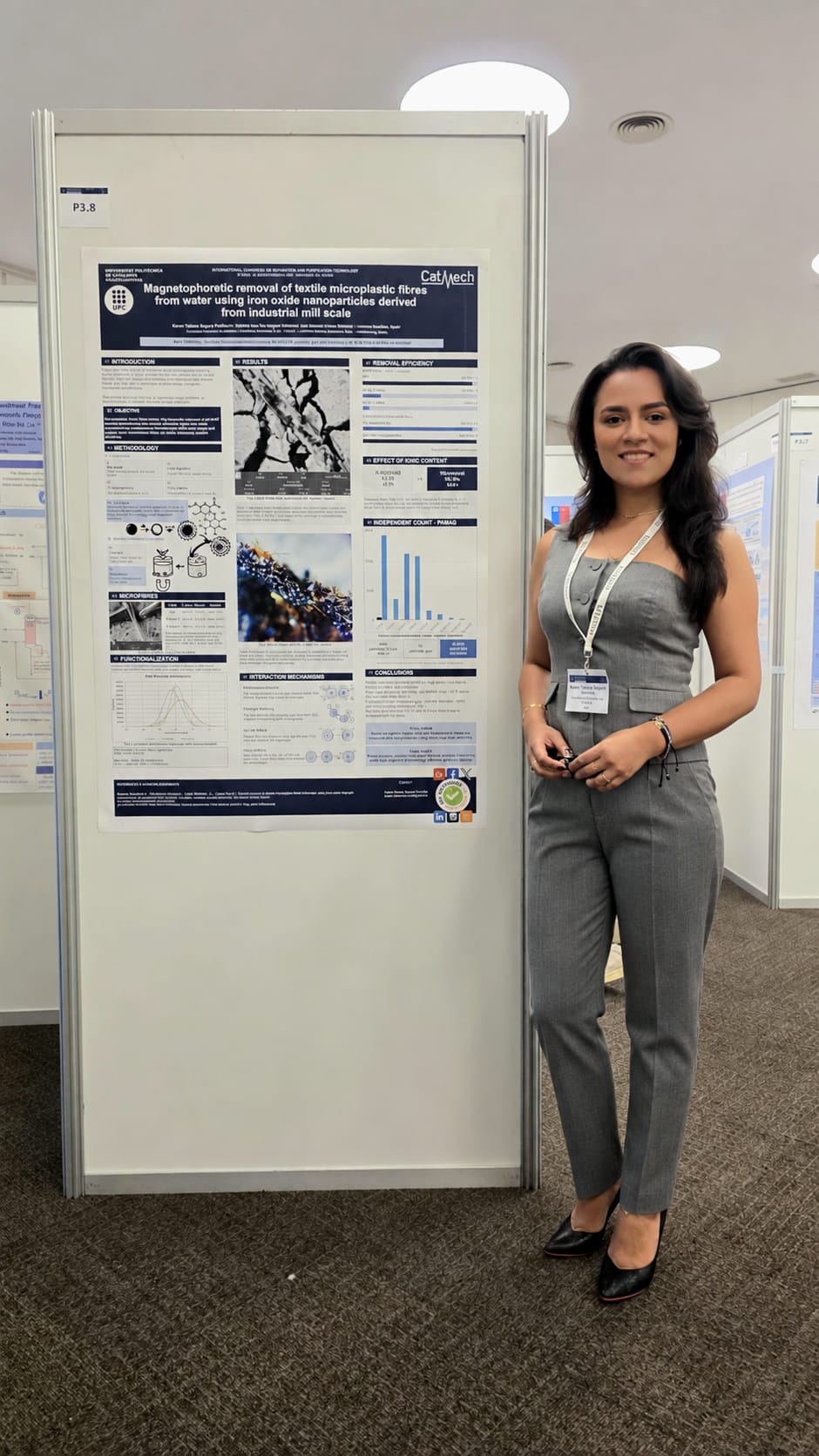
  • MicroTech presented its research at the International Congress on Separation and Purification Technology, held in Sitges, Spain, from 6 to 9 September 2026. The event brought together researchers working on separation and purification technologies.

    The poster, entitled “Magnetophoretic removal of textile microplastic fibres from water using iron oxide nanoparticles derived from industrial mill scale”, investigates an approach that combines industrial by-product valorisation with water treatment.

    The research explores the use of iron oxide nanoparticles obtained from industrial mill scale to enable the magnetic separation of textile microplastic fibres from water. By giving an industrial by-product a new potential application, the study connects materials recovery with efforts to address microplastic pollution.

    This work reflects MicroTech’s research into separation technologies and circular-economy approaches to environmental challenges and it is part of our work in REFIBMAG consortium. Its presentation at the congress provided an opportunity to share the team’s work with the international research community.

  • Associate professor and researcher Robert Castilla (CATMech – Fluids Division) has completed a teaching stay under the Erasmus+ Staff Mobility program at the Institute of Fluid-Flow Machinery of the Polish Academy of Sciences (IMP-PAN) in Gdańsk, Poland, from 20 to 24 July 2026.

    The intensive 12-hour educational program transferred high-level computational fluid dynamics (CFD) skills to doctoral students, enabling them to transition from terminal-based workflows using the classic pitzDaily tutorial to advanced, research-grade simulations of compressible and multiphase ejector flows using specialized open-source solvers such as HiSA, VOF (interFoam), and Euler-Euler (twoPhaseEulerFoam) with the OpenFOAM framework.

    This exchange modernizes doctoral CFD training and consolidates the cross-institutional research partnership in numerical fluid modeling between UPC and IMP-PAN.

  • Periods of intense academic activity can have a significant impact on students' mental well-being. To help address this challenge, MicroTech Lab has received funding from the Ajuntament de Terrassa through the 2026 Call for Projects, Activities and Services, within the Knowledge Transfer programme, for the MINDSTUDY project.

    Building on the experience and technologies developed in the EmotionalSigns project, MINDSTUDY (Monitoring and Supporting Mental Well-being in Students During Periods of Academic Stress) will investigate stress and emotional well-being in university students while developing a digital tool to monitor mental overload patterns and provide personalized support.

    The project will be carried out between June and December 2026 at MicroTech Lab (CATMech) and will combine research activities with knowledge transfer and awareness initiatives to promote healthy habits and mental well-being in academic environments.

  • MicroTech Lab has received funding from the Ajuntament de Terrassa through the 2026 Call for Projects, Activities and Services, within the Knowledge Transfer programme, for the FIBERCAP project.

    FIBERCAP (Development of a Microfiltration System for the Capture of Microfibres in Washing Machines) aims to study the generation of plastic microfibres during the washing of synthetic textiles and develop an efficient filtration system capable of capturing them before they are released into the aquatic environment.

    The project will combine experimental testing under real washing conditions with the development and validation of filtration prototypes supported by Computational Fluid Dynamics (CFD) simulations. Running from June to December 2026, FIBERCAP will also include knowledge transfer and environmental awareness activities.


  • We are pleased to congratulate Eva Chica on the successful defense of her Master's Thesis, "Separación de partículas de desgaste de neumáticos (TWP) mediante nanopartículas magnéticas funcionalizadas: estudio del estado del arte y validación experimental" ("Separation of Tire Wear Particles (TWP) Using Functionalized Magnetic Nanoparticles: State-of-the-Art Review and Experimental Validation"), as part of the Master's Degree in Research in Mechanical Engineering at the Universitat Politècnica de Catalunya – BarcelonaTech (UPC).

    On July 9, Eva successfully defended her thesis and was awarded an Excellent grade, recognizing the quality of her work and her dedication throughout the master's programme.

    Congratulations to Eva on this important academic achievement. We wish her every success in her future academic and professional career.

  • The EmotionalSigns project develops a minimally invasive technology to quickly monitor stress-related biomarkers, especially for people with communication difficulties. Led by UPC (Microtech Lab/CATMech), it focuses on sensors that detect cortisol and lactate in sweat and saliva, providing results in under 30 minutes. The system is designed for self-monitoring and well-being support, integrating microfluidics with physiological signals like HRV and GSR. Data will be transmitted wirelessly to a platform by 3DThinks, with support from the University of Barcelona, and the project is funded for three years under a public-private collaboration program.

  • Last 22nd of May Genis Rabost presented his work entitled "Microfluidics for sweat monitoring". We would also thank to the knowledgeble  Commettee to review his work: Prof. Emile Marticinc, Prof. Eloi Ramón and Prof. Ivon Rodriguez. Congratulations to all MicroTech Team (co-advisors and team members) for this new achievement: now we are one more doctor in the MicroTech Family.

  • In a move to foster strategic collaborations in the field of sustainable mobility, the Principal Investigator of the MicroTech Lab recently visited Applus+ IDIADA, a global leader in automotive engineering and innovation. The visit marked an important step toward building bridges between academic research and industry, with a focus on technological advancement, environmental responsibility, and human-centered design.

    With over 30 years of experience in vehicle development and validation, Applus+ IDIADA stands at the forefront of automotive innovation. The company’s holistic approach, based on a balance between cutting-edge technology, sustainability, and safety, aligns closely with the mission of the MicroTech Lab to deliver impactful research in advanced diagnostics and smart systems.

    During the visit, both parties exchanged insights on current challenges in the automotive sector, including the transition toward decarbonization, the integration of connectivity and automation, and the push for digital transformation through virtual testing environments. These priorities are central to IDIADA’s innovation strategy, which is proactively aligned with global trends and future mobility needs.

    The meeting opened the door to potential joint projects, drawing on MicroTech's research expertise and IDIADA's engineering capabilities to co-develop forward-thinking solutions for a safer and more sustainable mobility ecosystem.

    This initiative underscores the commitment of both institutions to fostering an innovation ecosystem through strategic partnerships—accelerating the development of next-generation technologies for the automotive industry.